
"I'm Not A Programmer” Will Be The New “I Can’t Read" In 5 Years
A new universal literacy is emerging. Most knowledge workers won't see it until they're locked out.

“Why are these people making the world so hard for me to live in? Everything worked fine before.”
My mom said this to me last year, and it sent a dagger into my heart. She is 74, retired, and was, I want to emphasize this, a computer engineer.
My mom is still the most independent-hearted person I’ve ever met, and I immediately knew what she was really saying. The shift was causing her to lose what she valued most: her independence.
The same pattern kept repeating:
Her old device would break (phone, TV)
She would get the new version, which was “smart” by default
The setup and usage would be overwhelming
She’d spend hours trying to figure out something that would take someone else minutes.
Until eventually, she’d either give up or get help.
With each new device that went “smart” and each offline process that went online, her independence eroded.
She did not see this coming. Almost nobody who gets left behind ever does. But the world was becoming more and more alien to her, and it felt like there was nothing she could do about it.
I’m writing this article because the same thing is about to happen again, on a drastically faster timeline, to a much larger group of people. And I think there’s a real chance that you’re one of them.
In fact, a huge percentage of people are already wondering the same thing about AI that my mom wondered about technology:
Why is this small group of people in Silicon Valley creating something that will completely disrupt my life, my plans for the future, my local community (in the case of data centers), and my decades of expertise that I’ve gone into debt for?
The resistance isn’t coming from where you’d expect either. This time it’s not just retirees struggling with new interfaces. Graduating seniors are booing commencement speakers for telling them to embrace AI. The people who would normally be most excited about the future are the angriest about it:
I resonate with the backlash.
Within two decades, AI may be orders of magnitude smarter, faster, and cheaper than any human worker, and there will be far more of it than there are of us. The downside scenarios are real.
But none of us get to opt out of the world we live in.
The knowledge workers who don’t embrace AI will be left behind, and no one is coming to bail them out. Those who embrace it will see their productivity shoot up to previously unfathomable levels.
But anger and excitement have one thing in common: neither one tells you what to do next…
The Most Dangerous Career Advice Right Now Is “Figure Out AI”
Everyone agrees AI is transforming the world. Almost nobody agrees on what that actually means for anyone’s career.
A clear, hopeful future has been replaced by fog. Now it’s hard to know whether AI will take all of our jobs in five years or just keep making us more productive and creative for the foreseeable future.
Therefore, it’s hard to know exactly what to do now. It’s hard to know which AI skills will pay off for years, and which will be obsolete by the time you finish learning them.
Many people are falling into one of two camps:
Opting out of staying on the AI frontier and burying their head in the sand.
Flailing around trying to do everything. Staying on top of the latest tools, AI models, AI harnesses, prompting techniques, and industry news. Working harder than ever, but not sure if they’re making real progress.
This article is about clarity.
It provides you with the one AI skill and the one category of tools that are virtually guaranteed to deliver the biggest return for knowledge workers who apply them.
This clarity is critical because once you know what won’t change, you know what to invest in now and can be confident it will pay off.
Not only that, based on Harvard research and early results of people who are making the switch (more on this later), I can confidently say that the skill you’ll need to learn is one that you’ll actually enjoy doing.
And if you haven’t started yet, that doesn’t mean you’re behind. You’re in Stage 2 of a 5-stage pattern. The window is still open.
Very few have felt the true magnitude and speed of what’s happening, because we’re all inside it. It’s so ever-present that it’s invisible. To really see it, you have to step outside of it.
This article will help you take that step outside.
The Multi-Century Pattern That Reshaped Civilization Twice Is Running A Third Time
In 1700, saying “I can’t read” carried no stigma. By 1900, it was a serious liability.
In 1990, “I don’t use computers” was a defensible position. By 2015, it ended careers.
Today, “I’m not a programmer” is normal. By 2030, it will sound the way “I can’t read” sounded in 1900.
I’m not predicting this flippantly.
We’re inside the third run of a historical pattern that has already reshaped civilization two and a half times:
Once for reading and writing (text literacy)
Once for counting and calculating (numerical literacy)
Finally, for using and authoring software (software literacy)
Just as reading literacy spread for centuries before writing literacy did, software usage (digital literacy) spread for decades before software authorship became mainstream.
Today, knowledge workers use dozens of software apps on their phones, in their browsers, and on their desktops. Someone who can’t use software is essentially unemployable as a knowledge worker.
Starting in November 2025, when AI agents became able to reliably create working code, we entered the second stage of the third literacy—Software Authorship —in which domain experts turn what they know into running systems using plain English, with AI doing the technical work.
On the surface, Software Authorship doesn’t sound like a civilizational shift on the scale of reading or arithmetic. For 50 years, software has been a niche specialty: built by highly paid engineers, used passively by everyone else. Calling it the next universal literacy feels like a stretch at first.
It isn’t.
On the surface, Software Authorship doesn’t seem likely to have much impact on the average knowledge worker’s day-to-day work and career trajectory.
It will.
On the surface, Software Authorship feels like the type of shift that will take decades to run its course.
It will likely take 5-10 years. Maybe less.
The shift will create a new generation of economic winners and losers:
Winners: On the one hand, the most advanced AI users creating software will be 100x, then 1,000x, and then 10,000x more productive than the average knowledge worker who lightly uses AI in chat. This is already happening, which I explain later in the article.
Losers: On the other hand, many people will be left behind. Way more and way faster than in any previous technological shift.
I see the tsunami coming, and 99% of people don’t recognize what’s about to happen. As a lifelong educator, my mission is to help people make this shift as smoothly as possible.
On a personal level, I feel motivated by both the opportunity and the risk:
Over the past few months, I’ve seen my productivity skyrocket higher than it’s been at any other point in my career.
I fear being left behind on a visceral level because my mom isn’t the only person I’ve watched be left behind in the past, and it’s brutal…
What Happens To The People Who Sit This One Out
A 2005 comment from a dear mentor still sticks with me:
“I used to be good at computers in the 80s. I shouldn’t have let my skill slip. Don’t make the same mistake I made.”
Earlier in his career, my mentor decided to be more productive by delegating technical tasks to his employees rather than learning them himself. Until one day, he woke up and realized four harsh truths:
He was completely dependent on others for basic tasks.
He had become the kind of person who got the warm handshake at the front of the room and the knowing look behind his back among employees.
He was losing contracts to others because he wasn’t keeping up with the times.
He was so far behind that he couldn’t catch up.
I remember one moment in my early 20s when he asked me for help with a very basic tech task. It felt so obvious, I couldn’t help but smirk. He paused, closely examined my face, and then immediately ended the interaction. He never asked me for tech help again.
Looking back, I see his vulnerability in asking for help and his shame at my response. I wish I could’ve responded differently.
He never did catch up.
My mom and my mentor weren’t stupid or lazy. On the contrary, during their careers, they were each ambitious and successful. They just didn’t develop a key universal literacy when they had the chance. And they didn’t realize what they’d lost until it was too late.
It’s the boiling frog problem. The water heats one degree at a time. The frog never feels the moment when it should jump out, until the moment when it can’t. AI is doing the same thing to most knowledge workers. Each new headline is interesting but not alarming. Each week, it still feels okay to start later. The water just gets a little hotter.
Realizing this, I started doing the one thing my mom and my mentor didn’t. In March 2023, I made the decision to focus on studying and writing about AI full-time.
Then last winter, my news feeds blew up…
I Spent Twenty Years Convinced I Wasn’t A Programmer. I Was Wrong.
I saw the most luminary programmers stop writing code all at once:
Given the latest lift in LLM coding capability, like many others I rapidly went from about 80% manual+autocomplete coding and 20% agents in November to 80% agent coding and 20% edits+touchups in December. i.e. I really am mostly programming in English now.
—Andrej Karpathy (former head of AI at Tesla), 40,000 likes
Pretty much 100% of our code is written by Claude Code + Opus 4.5. For me personally it has been 100% for two+ months now, I don’t even make small edits by hand. I shipped 22 PRs yesterday and 27 the day before, each one 100% written by Claude.
—Boris Cherny (head of Claude Code) on behalf of Anthropic’s team, 7,000 likes
programming always sucked. it was a requisite pain for ~everyone who wanted to manipulate computers into doing useful things and im glad it’s over. it’s amazing how quickly I’ve moved on and don’t miss even slightly. im resentful that computers didn’t always work this way. I 100%, I don’t write code anymore.
—roon (prominent OpenAI engineer), 6,800 likes
The era of humans writing code is over. Disturbing for those of us who identify as SWEs [software engineers], but no less true. That’s not to say SWEs don’t have work to do, but writing syntax directly is not it.
—Ryan Dahl (creator of Node.js), 20,000 likes
I also saw headlines like this:
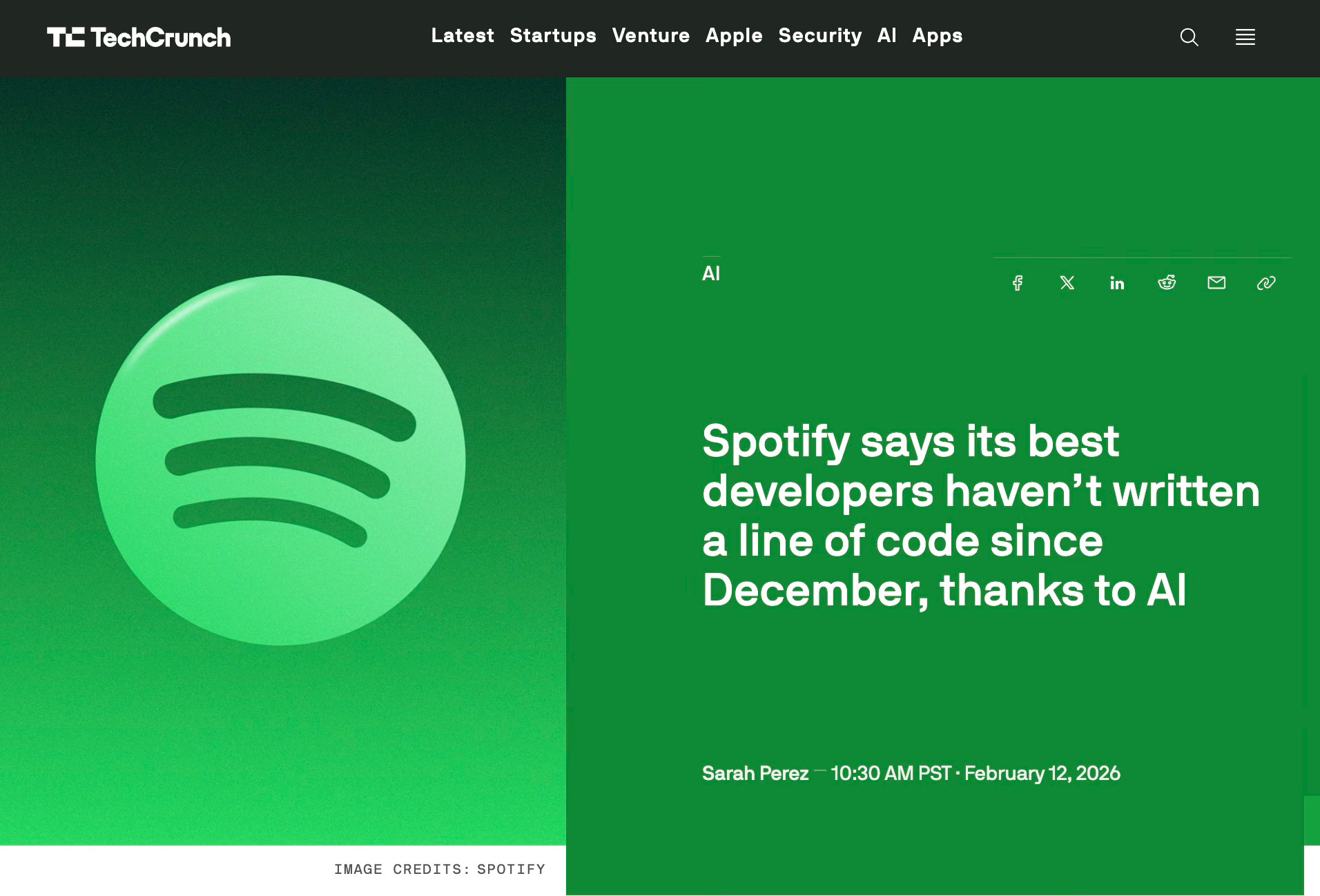
Before, AI would get you 80% of the way there, but you still had to manually fix the last 20% of bugs. Suddenly, people were saying that AI was doing all of their coding.
I knew I should try building software.
I was even excited by the idea.
At the same time, it also filled me with dread because I had already failed before, over and over.
My mom was a computer programmer. She encouraged me to follow that path. So in my teens, I bought the website design books and learned HTML and Adobe Photoshop.
Emboldened by my progress, I bought more advanced programming books and took a computer science course at school. But that’s when I hit a wall. Every time I pushed past the basics, the same cycle started:
I’d write something
It wouldn’t work
I’d spend the next three hours figuring out why
Fix one bug, start building again, hit another.
Most of my time went to debugging. It wasn’t fun.
There was no dramatic moment where I quit. I just gradually stopped trying and made a quiet decision about myself: I’m not a programmer.
After college, I tried the other route to creating software: hiring coders. I found an overseas development team and spent $40,000 over a year, working nights and weekends, building an app that let people track their goals.
I quickly learned what it feels like to depend entirely on someone else to build what’s in your head:
Because of the 12-hour time zone difference, one miscommunication cost a full day.
I couldn’t tell whether a fix should take an hour or a week.
I had no way to tell whether the work was high quality.
It was like bringing your car to a mechanic when you don’t know how a car works. You hand over the keys, you pay the invoice, you hope you weren’t lied to, and you hope your car works when you get it back.
Ultimately, the app failed.
Eventually, I lost interest because the whole process killed everything that made the idea exciting.
By the time AI coding tools arrived, I’d seen the data: virtually every successful software company has a technical founder.
At the same time, I said to myself, “I’m not a programmer. I’m a writer.” I’d made peace with it.
So, when Claude Code launched in 2025, my first reaction was: even if AI writes 95% of the code, I don’t want to spend all my time fixing the other 5%. Even with a shorter learning curve, not worth it.
Then came December 2025, when I saw everyone saying that AI could do 100% of coding. Even though I was interested, I didn’t make time for it. I was busy.
What finally broke through was a friend who sat me down in January and said, “I think you can do this. Let me just show you.”
In one call, he walked me through the basics and suggested a few things to try. For the first time in twenty years, I felt like the “programming door” might not be completely closed.
I tried it. And it wasn’t what I expected.
For my first real project, I decided to create a mental model manual.
I had spent four years creating these manuals by hand for my Mental Model Club. Each one took roughly 50 hours of research, writing, and editing. To start, I downloaded all of the old manuals onto my computer. Then, I asked Claude Code to analyze the structure of each manual. Finally, I asked it to produce a new one in the same structure.
Within a few minutes, I had created a manual on the Second Order Effects mental model. On my very first attempt, it was shockingly close to what took me a month to create manually.
That’s when the lightbulb hit me.
Over the next week, I created 300 more manuals with AI. Same depth as when I did it by hand. But way faster. The numbers didn’t lie:
Before AI: 192 weeks to create 48 manuals
After AI: 1 week to create 300 manuals
That’s an astounding 1,200x multiplier. And it had only cost me $50 (on top of my $200/month subscription).
Then I asked Claude Code to build something more complex. And it did. But the things I had to fix were never the code. My time was spent on:
Deciding what to build
Planning it out
Iterating with the AI
Judging what “done” looked like
For the first time, building software required my expertise, not someone else’s.
And because I wasn’t trapped in debugging hell anymore, something unexpected happened: I was having fun. Not in a forced way. Genuine fun.
I described what I wanted in plain English, and Claude built it. I didn’t write a single line of code. I didn’t read a single line of code.
The systems I’d dreamed about for years, but never had a way to build, were suddenly real. And building them turned out to be the most direct path to everything I’d wanted to do with my work.
After I built one tool, I built another. Then five. Then 20. Then dozens more. In just a few months.
Every one of those tools encodes my expertise in ways that no software company would ever productize, because the knowledge is mine. A 27-step news analysis pipeline built on years of mental models I’ve developed. A writing voice system that captures my exact style. An AI-powered research system with over 12,000 notes searchable by meaning, not just keywords.
None of it required me to be a programmer. It just required my domain expertise and my AI prompting expertise.
After months of spending most of my day programming, I noticed two things that surprised me.
First, I realized I was no longer just a thought leader who happened to program part-time. I was actually a programmer. For example, to generate articles like this one, I spent most of my time developing software to streamline the process. Within a few months, I went from not knowing how to code to identifying as a software engineer. It has been the fastest identity shift I’ve ever gone through in my life.
Second, I realized that I actually love programming now…
The Harvard Research That Explains Why I Was Wrong About How I’d Feel About Programming
There’s a Harvard psychologist named Daniel Gilbert who studies something called affective forecasting: our ability to predict how we’ll feel about experiences we haven’t had yet. His finding, across decades of research, is that we’re terrible at it.
We consistently overestimate how much we’ll hate many things we’ve never tried.
Gilbert’s lab has shown this across romantic breakups, tenure denials, election losses, and dozens of other events people are sure they’ll never recover from. They almost always recover faster than they predicted.
This TED Talk clip summarizes the research:
And, according to a follow-up study, the single best predictor of how you’ll actually feel?
Asking people who’ve already done it.
In the study, Gilbert and his collaborators asked undergraduates to predict how much they would enjoy a 5-minute speed date and a peer evaluation.
One group got detailed information about the event itself.
The other group got just one stranger’s reaction to the same experience.
The strangers’ reactions won.
People who relied on a single secondhand report predicted their own feelings more accurately than people who studied the situation in detail and then predicted how they would feel.
And the kicker: when participants were given the choice, they preferred the detailed information. They actively rejected the strategy that worked.
This research is relevant right now because most of the people who move to coding with AI actually enjoy it. Boris Cherny, the creator of Claude Code, says that this is roughly what he sees at Anthropic among people who make the shift. And Anthropic is at the leading edge of this wave.
Furthermore, Lenny Ratchitsky, who interviewed Cherny, found something similar when he did three polls on X that collectively got 1,500+ responses:
Below are the specific poll results:
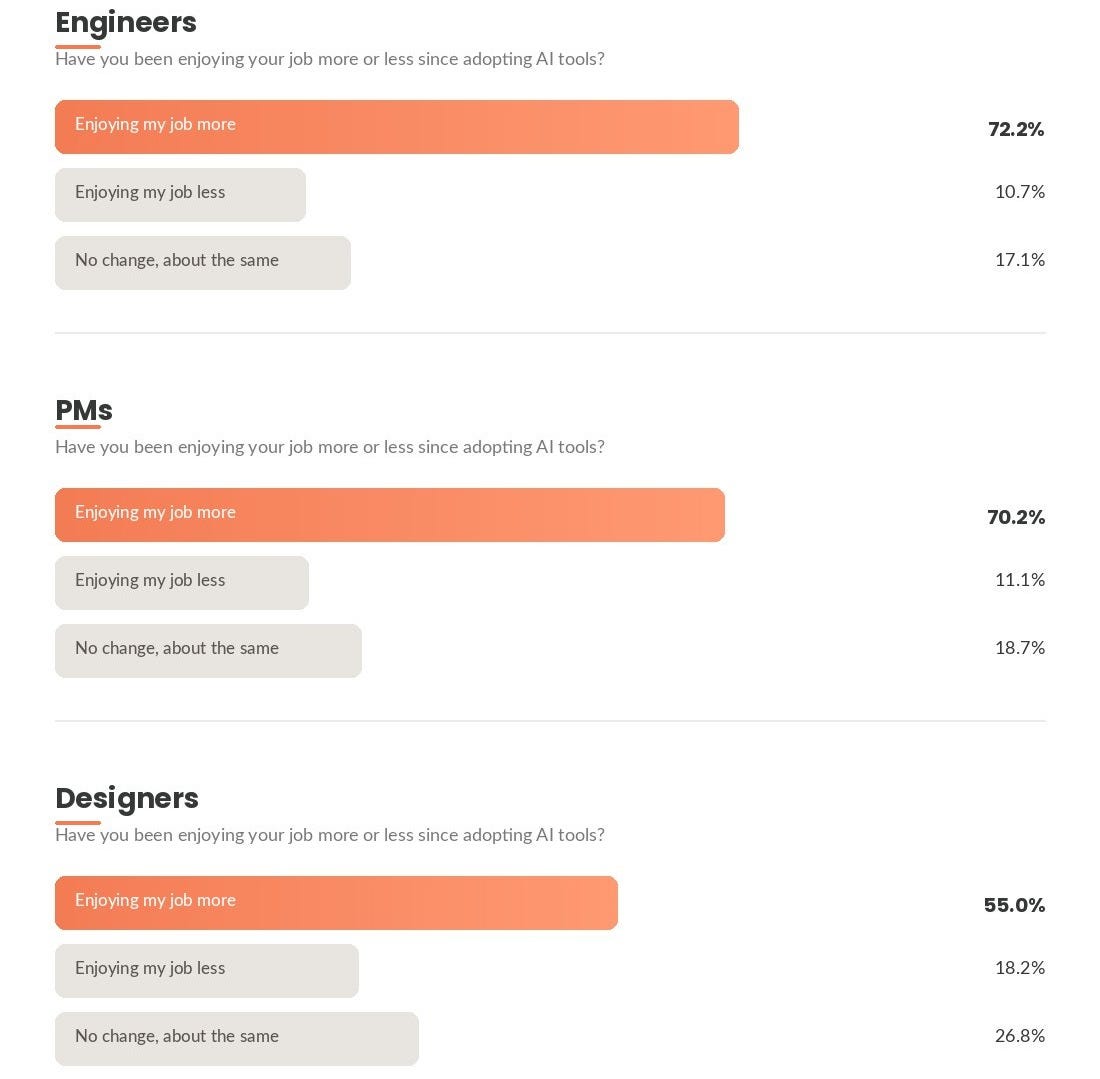
If Gilbert’s research holds and the trend continues, most people who switch to AI programming will enjoy it.
So the emotional barrier is probably lower than you think.
But there’s a second barrier most people haven’t questioned yet: the assumption that building software requires a different kind of thinking than you’re already using.
It doesn’t.
Your Job Is Already Software. You Just Don’t See It Yet.
Let me show you what I mean.
Strip away the job titles, and every knowledge worker is doing the same three-step loop all day:
Input. Take in information.
Transformation. Make sense of it, process it, create something.
Output. Export the result.
For example:
A lawyer takes in the details of the case, drafts the argument, and files the brief.
A marketer takes in funnel data, develops the angle, and ships the campaign.
An accountant records transactions, prepares the reconciliation, and sends the report.
A designer takes in references, develops the direction, and ships the layout.
Every one of those workflows IS fundamentally like software. Information in. Transformation in the middle. Information out. The shape of every knowledge worker’s job is the shape of a software workflow.
If you’re a consultant or a coach or a strategist and you just felt your jaw tighten at the idea that your job is “fundamentally like software,” I get it. I had the same reaction. My work felt too human, too intuitive, too judgment-dependent to be described that way.
But only the shape of the work is software. The soul of the work is domain expertise.
Looking at the full sweep of knowledge work, four distinct eras emerge, each one inverting the relationship between human and software a little further:
Era 1: Human With Mechanical Tools (before ~1980). Work happens entirely in the human’s head and hands with mechanical tools. Paper, pens, ledgers, typewriters. Software doesn’t exist as a workplace tool.
Era 2: Human With Software (~1980 to present). The human is the agent. Software is the tool. The human does the work, and the software helps along the way. The lawyer types in Word. The accountant works in Excel. The marketer logs into HubSpot. (This is where most of us still are. We’ve spent our entire careers getting very, very good at being the human in “Human With Software.”)
Era 3: Software With Human (2024 to present). The inversion happens. Software does the work. The human directs and judges. The founder doesn’t write the cold outreach. She designs a system that writes thousands of personalized messages while she sleeps. She isn’t using software the way her predecessors used Outlook. The software is doing the work. She’s directing it.
Era 4: Software-Only (~2030+). Software does the work autonomously without human direction in real time. Already true in narrow domains: algorithmic trading, automated support for routine cases, dynamic pricing engines, ad bidding. Likely to expand as Era 3 systems mature.
We are standing at the line between Era 2 and Era 3 right now. The professionals who have already crossed it are building 20x leverage. For example, serial entrepreneur Garry Tan is literally coding 400x faster than before AI:
Source: Y Combinator Podcast
Although Tan is an outlier because he’s an early adopter and world-class software engineer, he’s not alone. Legendary entrepreneur and investor Marc Andreessen reports that programmers in his portfolio company are 20x more productive with AI. This experience also aligns with my daily experience and that of friends who are all in on the tools.
I now believe that, in a year or two, people still operating with an Era 2 mindset (humans with software) will watch their work get done around them by people with a fraction of their experience.
The skill you need to move from Era 2 to Era 3 (software with humans) is Software Authorship: the ability to turn what you know into running software, using English as the interface and AI as the implementation. Not writing code. Just describing what you need, precisely enough that AI can code for you.
Boris Cherny is the head of Claude Code at Anthropic, the tool I use to build my own software. He stopped writing code entirely in November 2025 after AI became good enough to write it for him. But the most important thing he’s said isn’t about coding is about who builds the best software:
“The best person to write accounting software, I think maybe even today, is not an engineer. It’s a really good accountant because they know the domain really well. And coding is the easy part. It’s knowing the domain that’s the hard part.”
The technical part is now the easy part. The knowledge you’ve spent your career developing is the hard part. And “hard” here means “valuable.” It means “irreplaceable.” It means that the person who knows a domain most deeply builds the best tools, because the tools are made of domain knowledge now, not code.
This is why I’m saying that almost every knowledge job has software-shaped holes in it that better software would fill:
The reports your team runs that take hours to compile.
The data hand-offs between systems your IT department keeps promising to fix.
The dashboards you wish you had.
The custom tools that would make your job 40% easier, if only somebody would build them.
The only reason these tools don’t exist is because the supply of programmers has always been tiny relative to the demand for software.
That supply constraint just broke. Because now it’s possible for anyone to build.
The Five-Stage Pattern That Has Reshaped Civilization Twice Is Running Again
Everyone is asking, “Will AI replace me?”
That’s the wrong question for this moment.
The real question is bigger and older: what happens when a skill that only specialists have becomes something everyone can do?
That question has been answered exactly twice in human history. Both times, the answer unfolded as a five-stage pattern that reshaped economies, professions, and daily life. I call that pattern the Literacy Arc.
My mom and my mentor didn’t see the Literacy Arc until it was too late. The rest of this article lays out the full pattern so you can see where you are right now and respond better: the five stages, the two forces driving them, the historical precedent, and the specific window that will be open for the next few years.
READ THE REST OF THE ARTICLE
Paid subscribers get:
#1. The full article
The article is roughly 12,500+ words and includes 10+ videos and charts to make the ideas more concrete and visceral.
#2. A multimedia version
This includes slides and an audio podcast you can listen to while walking or doing chores. Scroll to the bottom of this post to access them.
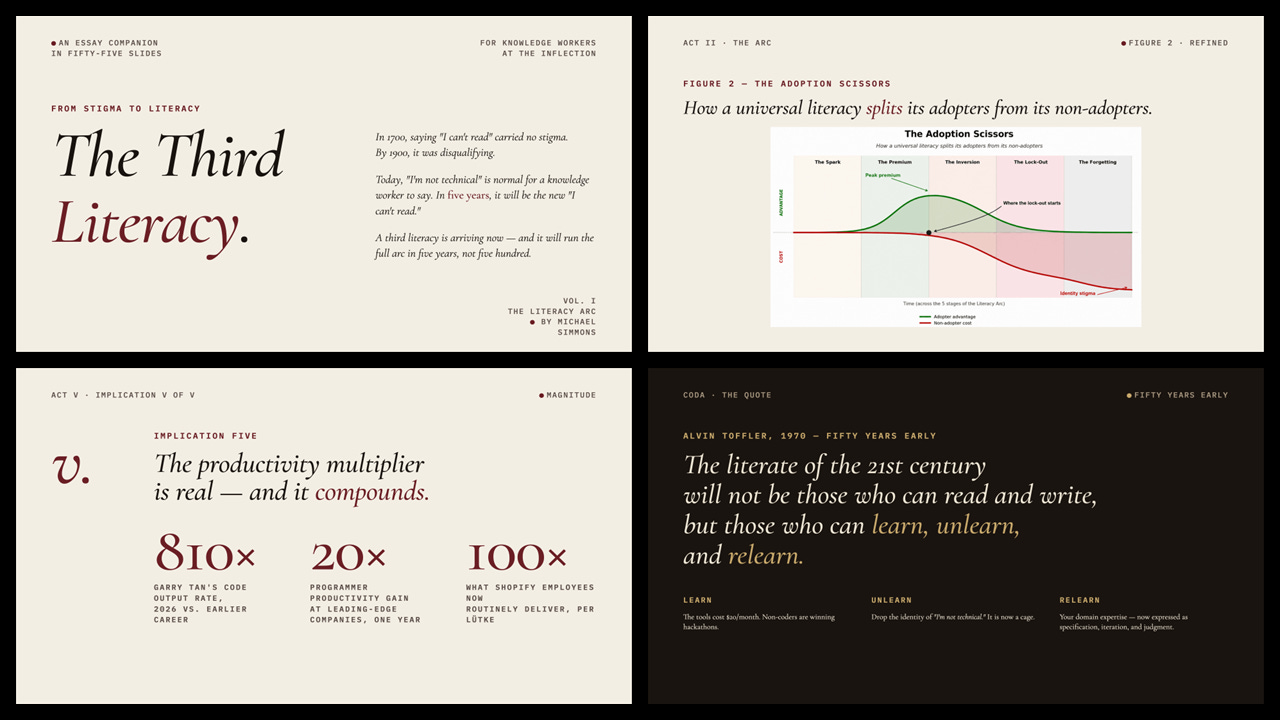
#3. Everything else that comes with the paid membership to this newsletter:
Blockbuster Live. This is a monthly 90-minute masterclass where I share my #1 AI lesson learned for the month.
Augmented Awakening. This is a monthly 90-minute session with world-class coach Anand Rao to help you use AI to augment your personal growth.
Weekly Blockbuster Article (often with a prompt). I share long-form articles about the deepest, most important AI mental models and paradigms that I see no one else writing about. These articles typically come with slides and an audio podcast.
$2,000+ In Other Perks. This includes books, courses, prompts, mental model manuals, and much more…
To summarize, you get two live classes per month, $2,000 in perks, and a weekly blockbuster article for just $20/month or $150/year.
Now let me show you the full pattern…
[insert paywall here?]
The Historical Pattern Behind What Cherny Described
I shared Cherny’s insight earlier: coding is the easy part, and the best person to build accounting software is a great accountant, not an engineer. But before he said that, he laid out a historical analogy that puts the whole shift in perspective:
“Before the printing press, essentially 10% of the European population was literate. They knew how to read and write. They were often employed by kings and lords that were not literate. And their job was to read and write. This is not something that everyone knew how to do.
The printing press was invented. And in the 50 years after the first printing press, there was more literature published in Europe than in the 1,000 years before. And over the same period, the cost of a book went down like 100x.
And then it took a couple hundred years because learning to read and write is hard. You need education systems and government and everyone can’t be working on farms and so on. But over the next few hundred years, literacy went up.
And so now we can all read and write and you don’t need a degree in reading and writing to know how to read and write. Although still there are professional writers and that is the thing that you can do.
So I think the thing that’s about to happen, and it’s going to be much faster than 50 years, is software will be a thing that is fully democratized that anyone can do.”
When I first heard Cherny lay this out, I felt two things at once:
Relief that someone had finally named the pattern I’d been sensing.
A chill at how fast he said the timeline would compress.
Both feelings turned out to be warranted…
There Is A Pattern Behind Every Universal Literacy. It Has 5 Stages.
What Cherny described follows the Literacy Arc that I introduced above. It evolves across five stages:
Stage 1: The Spark
Stage 2: The Premium
Stage 3: The Inversion
Stage 4: The Lock-Out
Stage 5: The Forgetting
Stage 1: The Spark
A technology arrives that makes a once-rare skill possible at scale:
Text literacy: Gutenberg’s press in the 1450s.
Numerical literacy: The switch from Roman numerals to the modern 0-9 digits, plus the first cheap printed math books that appeared in the late 1400s.
Software literacy:
Use half: The personal computer in the 1980s.
Authorship half: Late 2025, when AI models crossed the threshold of “good enough” code generation.
The Spark is mostly felt as a curiosity. The technology exists. The skill is possible. Almost no one has it yet.
Stage 2: The Premium
A specialist class learns the skill and earns a premium for it. Non-adopters experience no penalty.
Text literacy: Roughly 1450 to 1800. Notaries, secretaries, and clerks commanded a premium. Most workers were illiterate without consequence.
Numerical literacy: Roughly 1500 to 1800. Merchants and bookkeepers commanded a premium. Most workers traded in barter or memorized prices.
Software literacy:
Use half: Roughly 1980 to 2005. IT staff commanded a premium. Senior executives had their assistants handle email for a surprisingly long time.
Authorship half: Roughly 1980 to the present. Programmers still command a hefty premium compared to other knowledge work professions.
Stage 2 is the long, comfortable middle.
This is where my mentor was for most of his career: successful, respected, delegating the technical work to others.
This is also the stage where most non-adopters tell themselves one of three stories:
They will learn the skill “later.”
They can delegate it forever.
The skill isn’t as important as others say it is.
Stage 3: The Inversion
The premium collapses as the skill spreads. At the same time, daily life starts requiring the skill for the first time.
Text literacy: Roughly 1800 to 1850. Industrial economies started requiring written contracts, posted laws, and printed job descriptions.
Numerical literacy: Roughly 1800 to 1900. Standardized currencies and consumer pricing made counting required for ordinary commerce.
Software literacy:
Use half: Roughly 2005 to 2015. Banking, taxes, and job
applications all moved online. “I don’t use computers” went from a
defensible position to a quiet cost.
Authorship half: Began in November 2025 when Anthropic released Opus 4.5, the first coding model that could reliably produce working code.
This is the dangerous stage.
The non-adopter feels the first friction without yet recognizing what it is. Forms they can’t fill out. Conversations they can’t follow. The looks from their juniors. Contracts that don’t come.
Later in his career, my mentor had entered Stage 3 of the Literacy Arc. He could feel the change in the room. He did not yet have a name for it.
If you’re feeling a flash of recognition right now, that’s good. You still have time to act on it. The people who get locked out are the ones who feel the friction but explain it away.
Stage 4: The Lock-Out
The skill becomes a universal expectation. Non-adopters are structurally excluded.
Text literacy: Reached this stage by roughly 1850 in Northern Europe
and the United States. The illiterate could not sign contracts, read
posted laws, or hold most paying jobs.
Numerical literacy: Reached it by roughly 1900. The innumerate could not price goods, manage accounts, or hold professional positions.
Software literacy:
Use half: Reached it by 2015. The senior professional who never
adapted could not bank online, file taxes, or apply for jobs.
Authorship half: Hasn’t arrived yet, but is approaching faster than any previous literacy arc.
The Lock-Out is no longer a missed premium. It is a permanent closing of the door. When digital literacy was in The Premium, the IT desk walked you through using email. By the Lock-Out, the same desk rolled its eyes when you asked how to share your screen.
If that’s uncomfortable to read, good. It means you’re paying attention. The people who got locked out in the previous rounds weren’t careless. They were competent people who didn’t recognize the transition while it was still possible to act. The fact that you’re here, reading this, means you’re not them. Not yet.
Stage 5: The Forgetting
The literacy becomes invisible. Lacking it stops being a circumstance and becomes an identity. Someone who says, ‘I don’t know how to use Zoom,’ isn’t telling you about their education anymore. They’re telling you something about themselves.
This is what happened to my mom. She didn’t lose a skill. She lost her place in the world. And by the time she could name what had happened, the world had moved on without her.
Reading is in The Forgetting now. Arithmetic mostly is. Digital literacy will arrive there around 2030. Software authorship will follow soon after.
Where You Are In The Pattern Determines What Happens Next
By understanding each of the five stages and what it feels like to be inside them, we can better sense-make and respond:
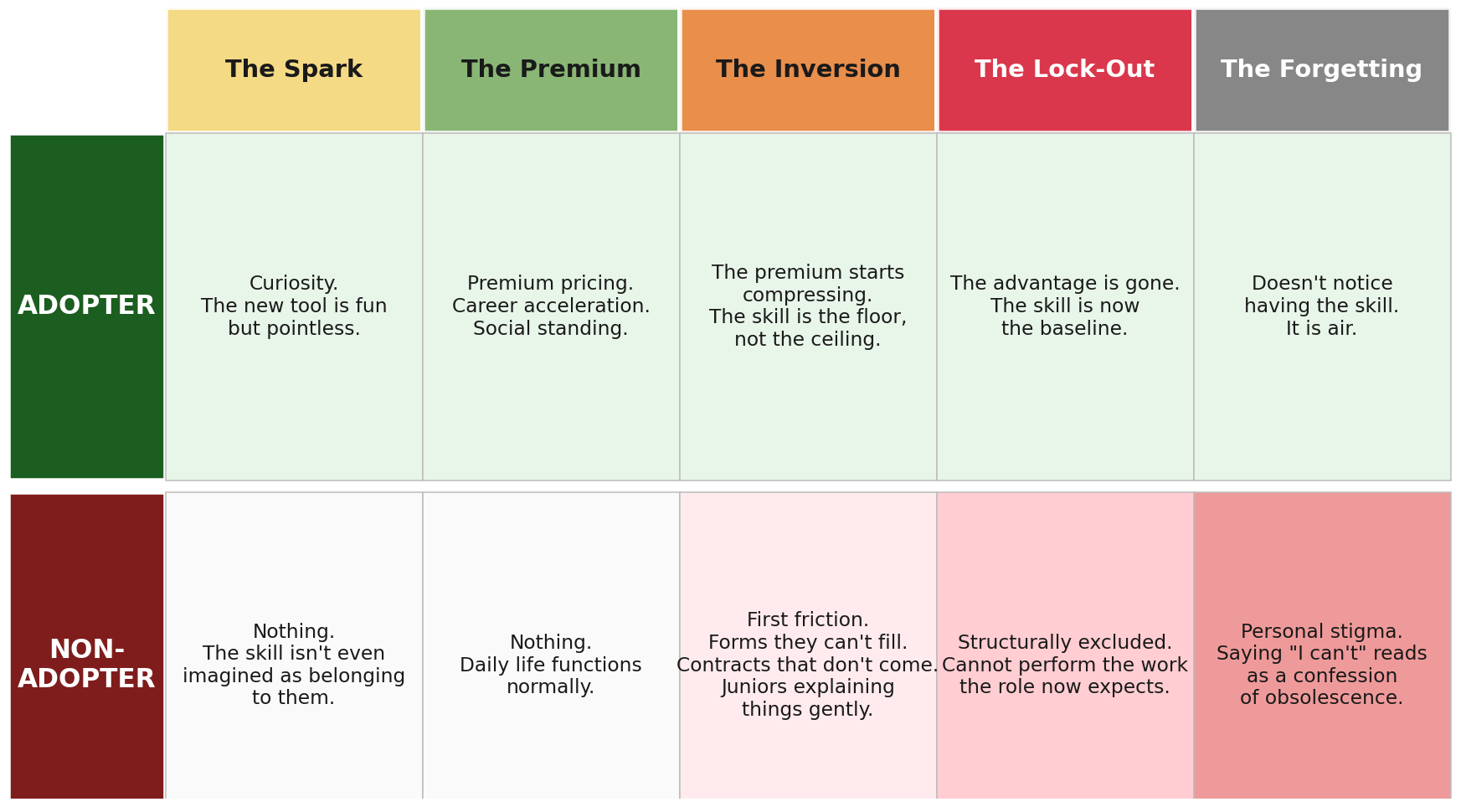
The five stages also help us understand the importance of acting sooner rather than later:
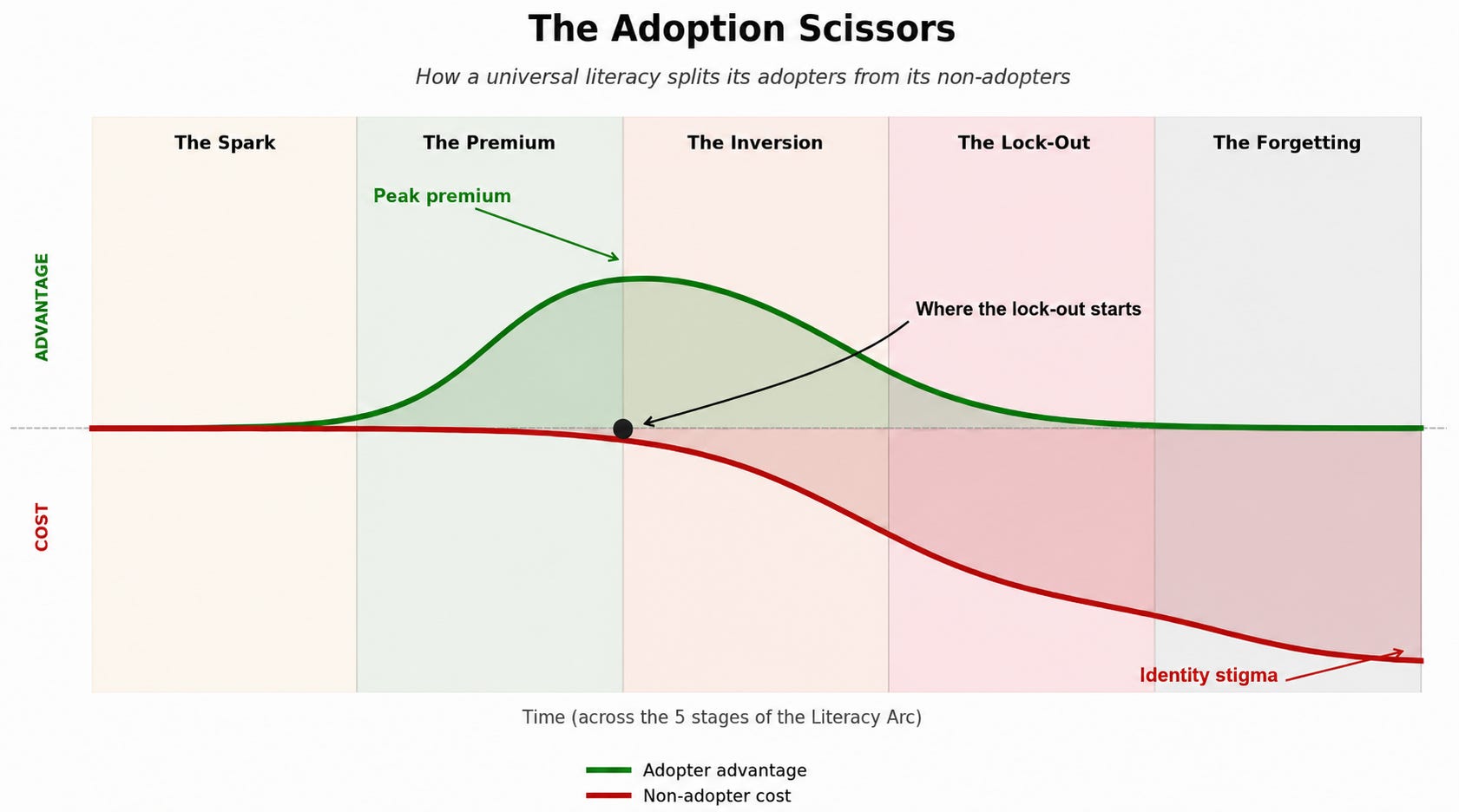
Seeing this moment as part of a cycle that repeats itself throughout history, rather than as a completely novel event, allows us to better contextualize the rapidly changing, alien world of AI.
Unfortunately, the Literacy Arc is invisible and counterintuitive for most people because the previous instances happened before we were born.
Fortunately, by studying analogous historical cycles, we can begin to build the same intuition we’d have built if we lived through them.
Famous investor Ray Dalio captures how studying these cycles helps us better invest our time and money in the following quote:
The times ahead will be radically different from those we’ve experienced in our lifetimes, though similar to many times in history.
[…]
To anticipate and handle situations that I had never faced before I needed to study as many analogous historical cases as possible to understand the mechanics of how they transpired. That gave me principles for dealing with them well.
Dalio’s approach is particularly important now.
Normally, a major cycle would give us decades to track it, get used to it, and see its consequences unfold. But AI is coming in like a “supersonic tsunami,” and our institutions and culture haven’t adapted yet:
Institutions: We can’t major in AI at school. Most companies have limited AI training, if anything.
Culture: Our peers, bosses, and colleagues are often just as confused.
We’re left to learn on our own. And the consequences of how we choose to educate ourselves are very real. There is no one coming to save us if we adopt too slowly.
To help us handle the AI software authorship “situation,” I’m going to take a page out of Dalio’s playbook and take us back to the 1400s to better understand the explosion of reading literacy…
First, the production of the artifacts (books, newspapers, magazines) had to become cheap
Every Literacy Arc runs on two forces:
Force #1 - Cheap Supply: a technology collapses the cost of producing the relevant artifact (books, numerical documents, software).
Force #2 - Universal Demand: daily life becomes saturated with that artifact until the skill goes from useful to necessary.
Both forces have to be present. When they combine, the Literacy Arc advances through all five stages. When only one is present, it stalls.
I’m going to walk through both forces in detail using reading literacy, because once you see how this pattern played out across 400 years, you’ll recognize the same pattern compressing over the next five.
Before Gutenberg, a single undecorated Bible took a scribe over a year to produce and required around 200 calfskins. Monasteries kept their own herds because buying skins on the open market would have bankrupted most scriptoria.
As a result, one Bible could cost over $100,000 in today’s dollars. Only churches and kings could afford a library.
Fortunately for us, book costs collapsed in three waves:
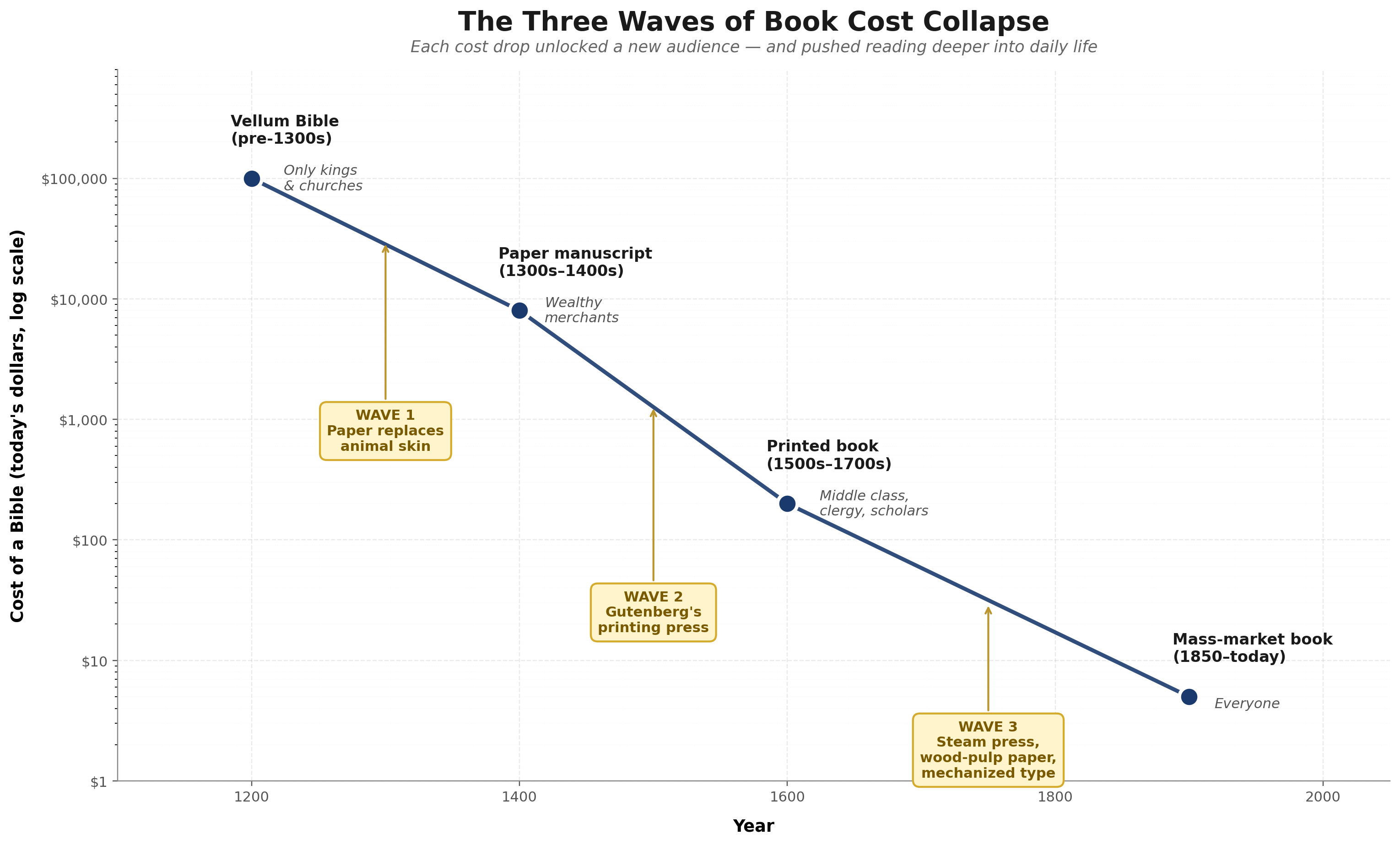
Wave #1 (Paper): Paper mills spread across Europe in the 13th-15th centuries, replacing animal-skin parchment.
Wave #2 (Printing Press). Gutenberg’s press arrived in the 1450s, lowering the cost from nobles-only to merchant-level affordability.
Wave #3 (Industrial Revolution). The Industrial Revolution brought steam presses and wood-pulp paper, making books cheap enough for everyone.
Today, you can get a hardcover bible for less than $10 with the literal click of a button. Universal literacy followed…
Second, the demand for reading had to develop
Cheap supply by itself never produces universal literacy. Even as the cost collapsed across three waves, it took roughly 400 years from the first wave for universal reading/writing literacy to arrive. The reason is that universal demand also had to develop.
Demand developed because each cost collapse didn’t just produce more books. It also produced an entire new universe of printed artifacts that hadn’t existed before:
Newspapers became viable.
Printed legal forms standardized contracts.
Shop signs and product labels became cheap to produce in volume.
Posted notices, almanacs, broadsides, printed schedules, and receipts entered daily life.
Each new artifact created new daily situations where reading was useful… and eventually, necessary. The daily situations created the demand. And the demand did the teaching:
Parents taught children at home.
Apprentices learned from masters.
People taught themselves from cheap printed primers.
Bottom Line: Low Price + High Demand = Universal Literacy
The low-demand skills that the new technology replaced, like calligraphy, became decorative arts. The cases where demand was high but production remained expensive (medical care, for most of history) led to professions being reserved for elites. Skills that become low-priced and high-demand became universal.
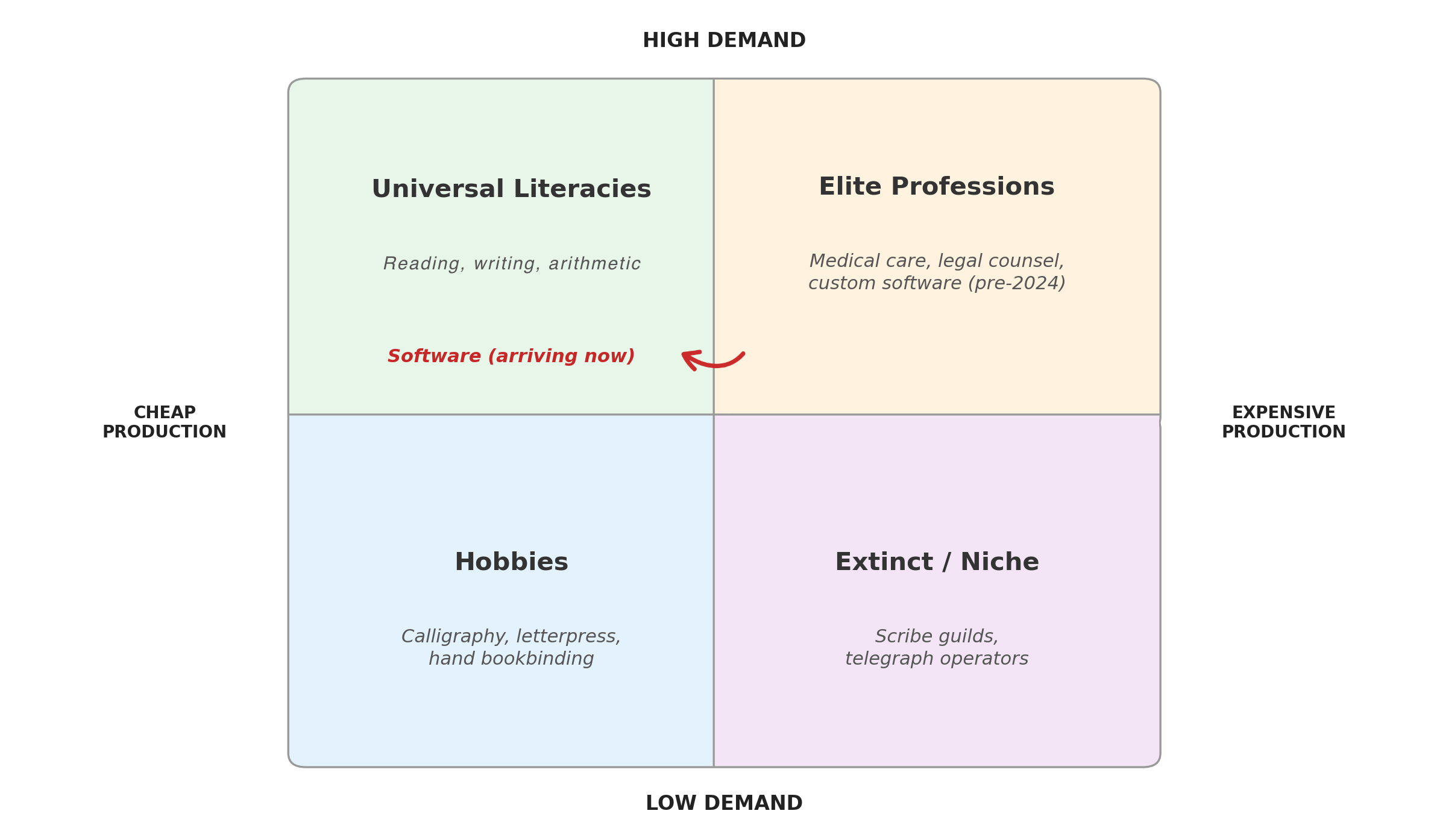
Arithmetic became universal the same way and in the same order.
Commerce (enabled by the printing press) made numerical artifacts cheap: standardized currencies, printed account books, price tags.
Trade created the demand and the literacy education. Merchants learned arithmetic through apprenticeships and self-study. The first printed math textbook in the West, the 1478 Treviso Arithmetic, was written in plain Venetian for traders to teach themselves, not for classroom use. People were numerate centuries before schools taught arithmetic.
Universal literacies start as consumption-focused (reading) and then become creation-focused (writing).
And the same is happening with Software Authorship right now:
Digital literacy: personal computers turned everyone into a software user.
Software authorship: AI coding tools are turning everyone into software creators.
Understanding this historical pattern of how literacies evolve gives me great conviction that software authorship will become a universal literacy.
To see how this just became possible, look at how both forces are interacting today:
Force #1: The cost of coding just collapsed
Force #2: The latent demand for software was released
Force #1. The Cost Of Coding Just Collapsed
While personal computers made it drastically cheaper to create software, coding was still expensive given that there are so few programmers, and learning to code takes lots of time and intelligence.
For 30 years, custom software cost between $10,000 and $100,000 just to start building. That price tag meant only large organizations could afford it. Solo professionals, small teams, and individuals had to live with whatever generic software they could buy.
In late 2025, that cost dropped by 97% with vibe coding tools like Replit, Bolt, and Lovable. As these tools became easier and more reliable, the number of non-coders who were coding suddenly skyrocketed:
Lovable went from 2.3 million users to nearly 8 million in 2025, with over 100,000 new projects built on the platform every day.
Replit has reached 50 million users.
Claude Code, the tool Cherny runs, became the first AI coding product in history to reach $1 billion in annualized revenue. By early 2026, it was reportedly on track to make $2.5 billion in a year.
Within months of launching, so many non-coders were using Claude Code for general knowledge work that Anthropic launched a separate product in January 2026: Claude Cowork.
The speed of adoption tells its own story. Most of the world’s software is stored on a platform called GitHub. Every time a programmer saves a new change, it gets recorded as a “commit.”
In September 2025, less than 1% of GitHub commits were being authored by Claude Code.
By February 2026, the number was 4%.
By May 2026, some estimates suggest the number exceeds 10%. And that’s just for one AI tool. Add in all the others, and the share of code being written by AI is dramatically higher.
Bottom line:
It is cheap, fast, and easy for people to create software now.
Force #2. The Latent Demand For Software Was Released
Remember those software-shaped holes in your workday? The reports, the hand-offs, the dashboards, the custom tools nobody ever builds? Those holes been there for decades. And there’s a reason nobody built software to fill them.
The programmers we did have were busy charging a lot and building products that scale to millions of users, not single-purpose tools for an auditor in Boston.
There’s no point in asking for software that nobody is going to build. So the demand for custom tools sat as latent friction inside every knowledge worker’s day, dismissed as “that’s just how things work.”
In 2025, the supply constraint broke.
Every knowledge worker is about to discover that their job was mostly software-shaped all along, and that the supply to fill that shape will be domain experts augmented by AI coding.
A reasonable objection at this point: if everyone can create software, won’t the advantage disappear as fast as it arrived?
Not necessarily. Every time the cost of producing software has dropped before, the demand for software grew faster than the supply.
Marc Andreessen lived through the last episode of this. In the late 1980s, “expert systems” arrived with predictions that programmers would soon be obsolete. On The Lex Fridman Podcast, Andreessen described what actually happened then, and what he expects from this round:
“Of anything in industrial society, code has the highest elasticity, which is to say, the easier it is to make it, the more it gets made. Effectively, there’s unlimited demand for code. In other words, there’s always some other idea for a thing that you can do, a feature that you can add, or a thing that you can optimize.
Overwhelmingly, the amount of code that exists in the world is a fraction of even the ideas we have today, and then we come up with new ideas all the time.
In the late ‘80s, early ‘90s when sort of automated coding systems started to come out. Expert systems were a big deal in those days. And there was a famous book called ‘The Decline and Fall of the American Programmer,’ that predicted that these new coding systems were gonna mean we wouldn’t have programmers in the future. And of course, the number of programming jobs exploded by like a factor of 100.
My guess is we’ll have more coding jobs probably by like an order of magnitude 10 years from now that will be different. They’ll involve orchestrating AI. We will be creating so much more software that the whole industry will just explode in size.”
— Marc Andreessen, Co-Founder, Netscape and a16z
Bottom line:
Force #2 has been active for a long time now. The demand was already there. It just had no supply to answer it. Now it does.
As a result of both forces, we’re now just beginning to see a new class of knowledge economy winners—domain experts with no coding background…
The New Winners Of The Knowledge Economy
Fast forward to February 2026.
The first-place winner of Anthropic’s coding hackathon didn’t know how to code. That was Michael Brown, a personal injury and traffic lawyer, who said afterward:
“It’s crazy to me that I ended up winning this contest, and I didn’t write a single line of code. I didn’t even read a line of code.”
What’s even crazier was who he was competing against. 13,000 people applied. 500 were accepted. 498 of those accepted were professional software developers with years of experience shipping products.
Brown built an AI-powered permit assistant for California ADUs, the backyard cottages and converted garages that the state has been pushing as a housing solution. As a result of his domain experience, he knew why these permit applications get rejected on first submission more than 90% of the time.
At the hackathon, he built a solution that would fix that. He spent six days explaining to Claude Code, in plain English:
How permit law worked
Which sentences or phrases a clerk would flag as problematic
Which language the office expected to see
What a successful application looked like.
He didn’t win first place because he was a better coder than the software developers he was competing against.
Brown won because he understood exactly what his app needed to do and what result it needed to produce, and he could describe it in enough detail that Claude Code could translate his specifications into code that worked.
Think about that. That’s like a behavioral psychologist who’s never played a hand of poker walking into the World Series of Poker Main Event and taking the bracelet.
Lovely Mcinerney saw the same thing from her accounting desk. She has Big 4 audit experience and runs quarterly closes for an investment fund, reconciling every asset, every depreciation schedule, and every dollar the fund has touched. For years, the knowledge she needed to do fixed-asset work either lived in her head or was buried in spreadsheets only she could follow.
She started encoding that knowledge into plain-English files and handing them to Claude Code. Her summary of what’s actually hard:
“The folder structure is easy. The hard part is deciding what goes inside.”
That sentence is the entire thesis of this article in one line. The technical part is now easy. Your domain knowledge is what matters.
Daniel Roth has been a journalist his entire career. He runs a 400-person editorial team at LinkedIn and has never learned to code. In the past year, he shipped Audio2, an app which turns podcast moments into shareable video clips, and Commutely, a real-time subway tracker for New York commuters. Both built by a career editor who can’t read the code inside them.
Bottom line:
Brown, Mcinerney, and Roth aren’t alone. There are now millions of people like them.
The production constraint is mostly gone now, and the progress toward making AI coding more reliable, secure, and scalable is happening faster than any other area of AI knowledge work.
The transition from a few million people to the broader knowledge economy may happen much more quickly than you think…
What Took Reading 400 Years Will Take Software Authorship 5 Years
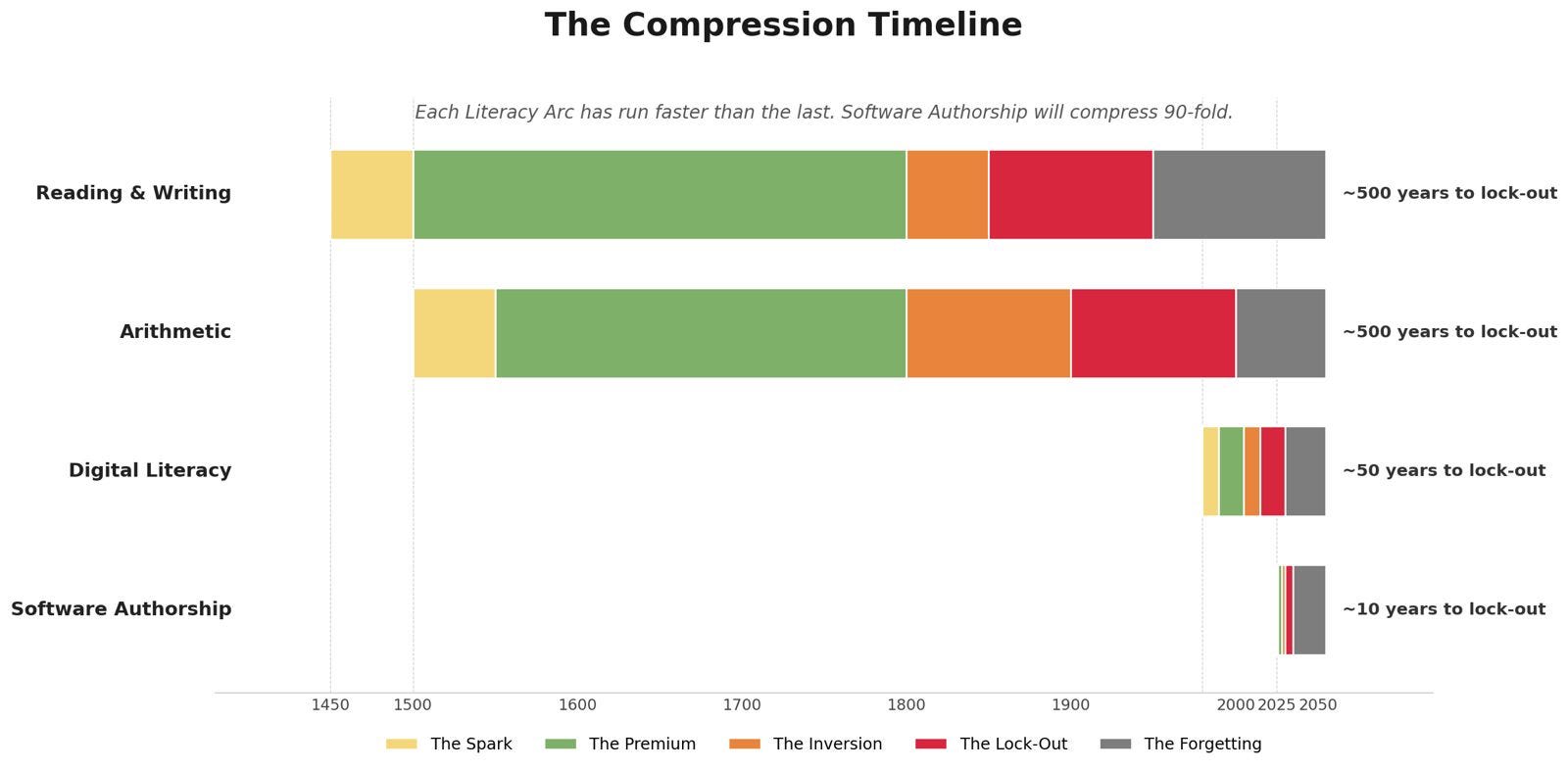
Text literacy took roughly 400 years from Gutenberg to universal schooling.
Arithmetic took about 400 years to move from merchant self-study to standard curriculum.
Software authorship will take fewer than ten.
I’ve felt this compression myself. The gap between the AI tools I started with in 2023 and what I’m using now is so large, it’s hard to describe to someone who wasn’t there for both.
On SWE-bench, the standard benchmark for real programming tasks, top AI systems went from solving roughly 2% of problems at the benchmark’s launch in October 2023 to nearly 90% on the verified subset today. The benchmark saturated so completely that OpenAI stopped reporting scores on it in 2026 and researchers had to release a harder replacement, SWE-bench Pro, where top models currently solve fewer than half of the problems.
Three reasons explain why:
AI companies understand coding
AI is uniquely good at code
AI that codes better can be used to build better AI
Reason #1: AI companies understand coding
The primary role inside AI research labs is coders. This means that all of the research labs deeply understand the challenges that coders face and how to alleviate them. Dario Amodei, co-founder and CEO of Anthropic, makes this point on The Lex Fridman Podcast:
“Programming is a skill that’s very close to the actual building of the AI. So the farther a skill is from the people who are building the AI, the longer it’s going to take to get disrupted by the AI. But programming is the bread and butter of a large fraction of the employees who work at Anthropic and at the other companies.”
— Dario Amodei, Co-Founder and CEO of Anthropic (2025)
In the following interview on The Dwarkesh Podcast, Amodei gives a concrete example of how this helped them:
Around the beginning of 2025, he told his engineers to start using Claude to accelerate their own research. The tool they built for internal use, originally called Claude CLI, saw such fast adoption that they launched it externally as Claude Code.
The engineers who build Claude now use Claude Code to write the code that makes Claude better. And when Claude gets better, Claude Code gets better, so the engineers can build even faster.
Reason #2: AI Is Uniquely Good At Code
Coding sits at the extreme easy-to-verify end of the problem spectrum. Noam Brown, who leads multi-agent research at OpenAI, has a framework for understanding which problems AI will crack fastest.
Problems have two components: generation and verification.
Certain problems are hard or subjective to verify (which poem is better?)
Other problems are easy to verify (is this math solution correct?)
When a problem is easy to verify, AI progress moves incredibly quickly, because the AI can iterate to the correct answer. Brown explains:
“You might call it a generator-verifier gap where it’s really hard to generate a correct solution, but it’s much easier to recognize when you have one.”
— Noam Brown, OpenAI, 2025
Writing software is hard. But checking whether software works is easy: you run it. It either does what you asked or it doesn’t. The feedback is instant, objective, and automatic. And AI is capable of doing the verification itself, generating millions of attempts, checking each one instantly, and learning from the failures without a human in the loop.
Compare that to a legal brief, where quality is subjective and requires a senior partner to evaluate. Or a medical diagnosis, where you might not know if you were right for weeks. Or a financial forecast, where the answer doesn’t arrive for a quarter.
This is also why your domain expertise is so valuable. The skills AI masters fastest are the ones where the output can be checked automatically. The skills that require human judgment to evaluate are, by definition, the ones that will require human judgment the longest. If your work is hard to verify, your expertise is hard to replace.
Code sits at the intersection of both advantages:
The AI builders know the domain intimately
The outputs can be verified automatically
This is why AI coding ability has improved faster than AI ability in almost any other domain.
Reason #3: AI That Codes Better Can Be Used To Build Better AI
The printing press could not improve the printing press. But an AI model that writes better code literally builds better AI models.
This self-reinforcing cycle did not exist in any previous wave of literacy. Text literacy and arithmetic literacy both depended on human institutions that improved across generations. But software authorship depends on a technology that improves itself quarterly.
Tom Davidson, an AI researcher at Open Philanthropy, has mapped this dynamic in detail: once you train an AI system as capable as a top human researcher, you can immediately run millions of copies in parallel, doing the work that small teams of experts currently do.
The result:
While the first two waves unfolded across four centuries, software authorship will be widespread within this decade. The clock speed for this wave of universal literacy is fundamentally different.
The Five Key Second-Order Implications For Knowledge Workers
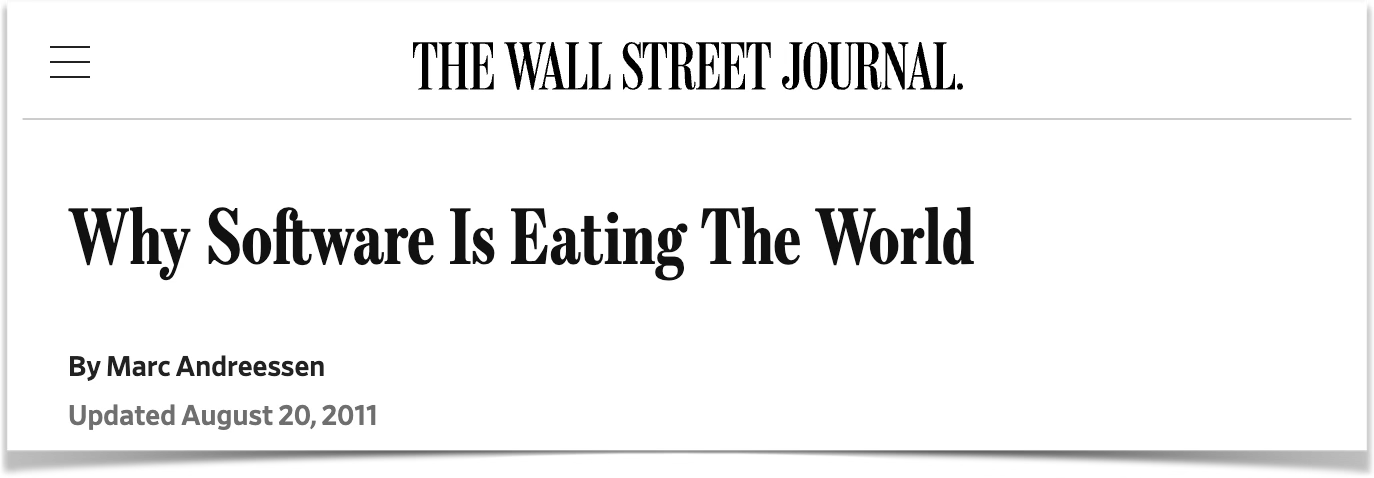
In 2011, when Marc Andreessen wrote in The Wall Street Journal that “software is eating the world,” he meant that software companies were about to displace incumbents across every major industry, from bookstores to taxi fleets to newspapers. At the time, Exxon Mobil was still the most valuable company on earth.
15 years later, the thesis played out exactly as he predicted:
9 of the 10 most valuable companies in the world are now software and technology companies, led by NVIDIA at over $5 trillion. As I’m writing this, the others include Apple, Microsoft, Alphabet, Amazon, Meta, Tesla, TSMC, SpaceX, and Broadcom.
But in another interview on The Lex Fridman Podcast, Andreessen asked a question his original thesis couldn’t answer:
Where are the hyperproductive people? If AI tools are so powerful, why hasn’t productivity exploded?
Software ate the world, but only the technical minority got to hold the fork. The other 99% of knowledge workers could use software but couldn’t create it. The tools were powerful, but the interface was locked.
Now the interface is English, and the implications change everything about how knowledge work is structured.
Five implications in particular stand out:
Implication #1. Domain expertise becomes the scarce resource
For 50 years, the limiting factor in building software was technical skill. That equation is inverting. The deepest expert in every field suddenly has something no software engineer can replicate:
Visioning. Envisioning what to build out of the universe of things you could possibly build.
Specification. Articulating how you want the system to work, precisely enough that an AI can act on the description.
Iteration. Guiding the AI’s output through successive rounds, closing the gap between “almost right” and “right.”
Judgment. Evaluating whether the output fits the intent. Cherny said it plainly: “Coding is the easy part. It’s knowing the domain that’s the hard part.”
Brown proved it at the hackathon. He didn’t beat all those developers because he was better at code. He beat them because he understood permit law at a level no software engineer could match. His system was powerful because Brown’s domain knowledge was encoded at the right level of detail and nuance.
Here is what this means for everything you’ve already built: every year you spent learning your domain, every hard case, every pattern you internalized, every judgment call you learned to make without thinking, all of it just became more valuable, not less. The investment wasn’t wasted. It was preparation for a moment where the only thing standing between an idea and a running system is the depth of the knowledge behind it.
Will AI eventually develop that depth of domain expertise on its own? Possibly.
But that’s exactly why the window described in this article matters.
Implication #2. “I’m not a programmer” stops being a valid professional identity.
For generations, knowledge workers have sorted themselves into “technical” and “non-technical” as though these were permanent traits. Résumés announce these identities. Job descriptions enforce them. Entire career paths were built around which side of the line you fell on.
For twenty years, I organized my entire career around “I’m not a programmer.” It explained a whole category of things I didn’t do and wasn’t going to try. Letting go of that identity was harder than learning any tool.
I’m not the only person crossing that line, now that the interface to building software has shifted from code to English. Brown, Mcinerney, and Roth all wrote zero lines of code. What they wrote were clear descriptions of what they needed, in the language of their own domain.
What most people miss: the line between “technical” and “non-technical” has never been fixed. It’s been moving your entire career. And depending on your age, you may already have crossed it as many as three times.
In the 1990s, using a computer at work was a technical skill. Senior professionals had assistants who handled email, printed documents, and managed digital calendars. “I don’t use computers” was a reasonable professional position. By 2005, it was a career-limiting one. The skill stopped being called “technical” and started being called “work.”
In the late 1990s and early 2000s, finding information was a technical skill. Professionals relied on librarians, research departments, and junior staff to look things up. Then search engines made it trivial. By 2010, a professional who “doesn’t Google things” wasn’t principled. They were handicapped.
In the 2010s, working with data was a technical skill. Analysis lived with BI teams and dedicated analysts. Then tools like Google Analytics and Tableau put basic data work within reach of anyone. By 2020, every marketer, product manager, and executive was expected to be “data-driven.” The ones who said “I’m not a numbers person” couldn’t justify their own decisions.
Each time, the same thing happened:
A tool made a specialist skill accessible.
The skill migrated from “technical” to “expected.”
The people who clung to the old identity found themselves dependent on specialists for things their peers now did for themselves.
And each cycle moved faster than the last.
The Literacy Arc tells you exactly where this ends. The shift from illiteracy being normal to being unacceptable took reading centuries. For software authorship, it will take a decade or less. Possibly much less.
Implication #3. Software becomes personal, not just institutional.
Today, software is something your company buys. Salesforce. SAP. Workday. Big platforms built for millions of users, none of whom get exactly what they need. Knowledge workers spend years learning to navigate the limitations of tools that were never designed for their specific workflow.
Software authorship changes the unit of production. Instead of one tool for 10 million users, you get 10 million tools for one user each.
The lawyer builds a permit assistant that fits his exact jurisdiction.
The accountant builds a depreciation tracker that matches her exact fund structure.
The editor builds a clip tool that fits his exact editorial process.
This is not a marginal improvement to existing software. It is a different category of software entirely.
Before universal literacy, personal writing didn’t exist. If you needed a message sent, you hired a scribe.
After universal literacy, you just wrote. And the diversity of personal writing turned out to be enormous: letters, diaries, grocery lists, notes to self, to-do lists, journal entries, thank-you cards. Nobody thinks of these as “writing” in the professional sense. They’re life infrastructure.
Likewise, personal software isn’t “custom software.” It’s externalized expertise. In the same way that a personal letter externalizes what you think in a way no published book can, personal software externalizes what you know and how you work in a way no SaaS product can.
I mentioned my 87 tools earlier. Here’s what’s actually inside three of them:
A 27-step news analysis pipeline that runs every AI news event through my specific model of how technology reshapes society: 2,000+ mental models, 300+ paradigms, 20 first principles, 11 analytical frameworks, 200+ effect chains, four master scenarios with probability weights. No other analyst has this model. It took me years to build the thinking. The software took weeks.
A writing voice system that encodes my exact style: my signature phrases, my structural moves, a library of my actual published sentences that get transplanted into new articles. It’s 1,200 lines of my craft, externalized.
An AI Second Brain with over 12,000 notes, searchable by meaning, not just keywords. When I start a new article, the system surfaces my own prior thinking, connections I’d forgotten, tensions between ideas I haven’t resolved yet.
These are my unique expertise, made into running systems, built by me, even though I’ve never written a line of code.
Implication #4. Knowledge workers become capital creators, not just labor sellers.
Marc Andreessen made an observation on The Lex Fridman Podcast that reframes the economics of what we’re describing:
Software is “our modern philosopher’s stone” because it “transmutes labor into capital.”
Someone sits at a keyboard, types, and a capital asset comes out the other side. An asset that works when they don’t. An asset that can compound for decades.
Until now, that transmutation was reserved for software engineers and the entrepreneurs who could afford to hire them. Everyone else sold hours.
Software authorship extends the transmutation to every knowledge worker. Brown’s permit assistant isn’t equivalent to billable hours. It’s an asset that processes applications whether he’s at his desk or not.
Mcinerney’s depreciation tracker isn’t a spreadsheet she maintains. It’s a system that runs her fund’s quarterly close.
Roth’s clip tool isn’t a favor he asked engineering for. It’s infrastructure that his 400-person team uses daily.
The ceiling for knowledge workers has often been: work more hours, charge more per hour.
Software authorship changes the ceiling to:
How many capital assets can you create from what you know?
The first time I built a tool that ran a process I used to do by hand, and it worked while I was asleep, something shifted in how I understood my own career.
I wasn’t selling hours anymore. I was building things.
That shift felt less like a productivity hack and more like a change in what my work actually was.
Implication #5. The productivity multiplier is real, and it compounds.
As briefly shared earlier, Garry Tan is the CEO of Y Combinator, the most influential startup accelerator in the world. In 2008, he co-founded a blogging platform called Posterous. It took a team of ten, $10 million in venture funding, and two years to build it.
In early 2026, Tan rebuilt the whole thing. Alone. In 90 hours. While having a full-time job and kids. Using AI. Only weeks after learning Claude Code.
The codebase is over 70,000 lines. He has never looked at a single one.
He described the experience this way:
“I took modafinil just to stay awake longer to be able to turn the momentary crystalline structures I had in my brain into lines of code before sleep or human distraction turned it to grains of sand. I love coding, but I love coding with AI even more. I speak, it listens, and we create. I see the structure and it is built.”
— Garry Tan, TechCrunch, March 2026
Tan tracked the numbers. His 2026 output rate is 810 times his previous coding pace: 11,417 logical lines per day versus 14 lines.
This is not an isolated case. Marc Andreessen is seeing the same thing on the investment side. On The Monitoring The Situation Podcast, he told this story about one of his partners at Andreessen Horowitz:
“We have one partner who’s built an entire AI system for everything that he does at work, and he is absolutely excited about it, and it works great, and he loves it. And it’s like his partner in all of his work now.
And I asked him, I said, have you looked at the code? And he’s like, ‘Hell no.’
He’s not a programmer by background. And yet all of a sudden he’s hyperproductive.”
“At our leading-edge companies, estimates are the leading-edge programmers are like 20x more productive than they were a year ago. Like, it’s the most dramatic increase in programmer productivity in, like, ever. And coding is the first domain in which this has happened. Now people want to project forward and say this is going to happen in every area of knowledge work. And I think you can predict a similar outcome.”
— Marc Andreessen, Co-Founder of a16z, MTS Podcast, 2026
This same pattern is showing up inside large companies, not just startups. Tobi Lutke, the CEO of Shopify, sent an internal memo in April 2025 describing what he was seeing across the company:
“I’ve seen many of these people approach implausible tasks, ones we wouldn’t even have chosen to tackle before, with reflexive and brilliant usage of AI to get 100X the work done.”
— Tobi Lutke, CEO of Shopify, Internal Memo, April 2025
Lutke didn’t frame it as an opportunity. He framed it as a mandate: teams must now demonstrate why they cannot get what they want done using AI before requesting additional headcount.
At Anthropic, the average increase among all developers since Claude Code was released in 2025 is 250%, with no decrease in quality, according to Boris Cherny. To put this in perspective, when he worked at Facebook, before AI models, the average increase in productivity per year was 1-3%:
Source: Boris Cherny on the Big Technology Podcast
Before Anthropic, I used to work at a big tech company [Facebook]. One of my responsibilities was the health of all of the code across Meta’s apps. So this is Facebook, Instagram, WhatsApp. And ne of the reasons that we care about the health of the code, and this is essentially things like code quality is engineers are more productive. And there was a big team of people that worked on productivity. Before models like Claude, you would work for a really long time, and you would see maybe a 1-3% improvement in productivity per engineer over the course of a year, something like that. And that was a pretty big improvement. And it was a very hard one. You essentially had to try a lot of ideas, and eventually you find something that improves productivity.
What happened with Claude is now many companies, including Anthropic, and all of our biggest customers, are reporting gains on the order of hundreds of percentage points. And I think the last number that we reported is the amount of code written per engineer at Anthropic has grown something like two hundred and fifty percent since we introduced Claude Code. And this is while keeping code quality and reliability and all of these things kinda stable. So without those things regressing, the volume of code has grown a lot.
This kind of productivity impact I think is just very new.
Reid Hoffman’s #1 AI advisor runs 54 parallel agents and checks in just once a day on many of them:
Cherny takes things a step further and runs hundreds of parallel agents at once overnight:
Source: Boris Cherny on the Big Technology Podcast
The question is not whether this multiplier is real. The data is already in. People at the frontier are experiencing it. The question is whether you’re on the compounding curve or watching it from outside.
The Software Authorship Window Closes Around 2030-2035. You Have 5 Years.
The Literacy Arc has a window between Stage 2 and Stage 4: the period when the skill is available but not yet universal. For reading, that window lasted 400 years. For arithmetic, 400 years. During those windows, the people who could read, write, and calculate captured asymmetric advantage.
They ran the businesses. They held the offices. They wrote the laws.
The software authorship window opened in late 2025. It will close in the next 5-10 years.
The CEO of OpenAI, Sam Altman, is already seeing this play out. At Stripe Sessions in 2026, he said:
“For a long time, I think the most important ingredient that I looked for, YC looked for, that this part of our industry looked for on a founding team was technical talent. And that’s still very important, but now people who just really deeply understand their users and can’t code at all, I want to fund those people. And that’s a big turnaround.”
— Sam Altman, CEO of OpenAI, Stripe Sessions, 2026
He called it “the revenge of the idea guys.” For decades, Silicon Valley dismissed people who had great ideas but couldn’t build them. Altman is saying the dismissal no longer holds. And he’s not just saying it. He’s deploying capital behind it.
Altman is also funding the technology that will eventually close the window he’s telling people to climb through. The better AI gets at coding (and everything else that once belonged solely to humans), the more quickly Stage 4 approaches.
No one knows exactly when AI will be able to do everything a human knowledge worker can do. But the people closest to the technology have guesses, and they’re worth hearing, because they aren’t speculating from the outside.
They are building the very systems that enable Software Authorship.
They are working with models that are six months to a year ahead of what the public has access to.
They understand the trajectory of the technology because they are creating it.
Yes, they are biased. They have every incentive to overstate the pace. But they also have something almost no one else has: direct contact with where these systems are right now and where they are heading next.
Here are the three most prominent AI leaders in the world, in order from the longest to the shortest predicted timeline.
Demis Hassabis, the CEO of Google DeepMind and a Nobel Prize winner in chemistry, has been working toward artificial general intelligence since he co-founded DeepMind in 2010. At the time, almost nobody was working in AI, and most people in tech thought the field was a dead end. His co-founder, Shane Legg, wrote blog posts back then predicting when AGI would arrive. Those posts are still on the internet.
“We’ve been very consistent how we define AGI as basically a system that exhibits all the cognitive capabilities the human mind has.
[…]
I’ve got a probability distribution around the timings, but I would say there’s a very good chance of it being within the next five years. So that’s not long at all.
[…]
We used to do this extrapolation of compute and algorithmic progress, and basically we predicted around 20 years it would take from when we started out, and I think we’re pretty much on track.”
— Demis Hassabis, CEO of Google DeepMind
Hassabis points out that DeepMind has been on track with its original 20-year prediction since 2010. This isn’t a sudden burst of optimism. It’s a forecast that has held for over 15 years. If he’s right, AGI is only four years off.
Dario Amodei, the CEO of Anthropic and the company behind Claude, puts the timeline closer.
“There’s a lot of problems that are basically, like: ‘we can do this when we have the country of geniuses in a data center.’ ...If you made me guess, it’s like one to two years, maybe one to three years, it’s really hard to tell. I have a strong view, 99%, 95% that, like, all this will happen in 10 years. I think that’s just a super safe bet. And then I have a hunch, this is more like a 50/50 thing, that it’s going to be more like 1 to 2, maybe more like 1 to 3.”
— Dario Amodei, CEO of Anthropic
Amodei’s framing is unusually precise for this kind of prediction. He is nearly certain (95-99%) that AI will match all human cognitive capabilities within ten years. His personal hunch, at 50/50 odds, is that it happens within one to three years.
Elon Musk, who runs xAI (the company behind Grok) in addition to Tesla, SpaceX, and several other companies, gives the shortest timeline of all.
“I’d be surprised, by the end of this year, if digital human emulation has not been solved. Can you do anything that a human with access to a computer could do?”
— Elon Musk, CEO of xAI, Tesla, and SpaceX
Musk believes AI could match any human performing knowledge work by the end of 2026.
So the range, from three of the people arguably most responsible for building AGI, is sometime between the end of this year and four years from now.
I don’t know who is right. Nobody does. But if Amodei and Musk are closer to the mark, the breakthrough that pushes AI across that line could happen very, very soon.
That said, here is what I want you to take away from this section. It isn’t the specific date.
Even if AI never gets a single percentage point better than it is today, the case for software authorship is already overwhelming. AI is good enough right now for anyone to build custom software that transforms their productivity.
If AI never gets any better than it is today, it’s still good enough to drive this third universal literacy arc we’re in to completion.
The window is closing, no matter what.
But the people who are building with AI today are already capturing the same kind of premium that scribes captured in 1500 and merchants captured in 1600: the advantage that comes from having a skill that most of your peers haven’t developed yet.
If you join them, you’ll also enjoy:
An exponential increase in productivity and creativity.
The ability to spend more of your time on the work only you can do.
The capacity to turn your knowledge into systems that run whether you’re at your desk or not.
That premium is available to you right now. And the advantage compounds.
An accountant who builds her first tool this year and learns from the experience will build her fifth tool next year and her twentieth the year after that. She will develop the visioning, specification, iteration, and judgment skills that can only be built through practice.
The question isn’t whether AI will eventually do all of this without you. The question is whether you’ll have built your advantage before it does.
You’ve Already Done the Hard Part
A friend sat me down and said, “I think you can do this. Let me just show you.”
That single conversation changed the trajectory of my career.
He didn’t teach me to code. He didn’t walk me through a tutorial or assign homework.
Instead, he showed me that the barrier I’d been running into for twenty years was gone. That the thing standing between me and building software had been quietly removed, and I hadn’t noticed.
What my friend saw, and what I couldn’t see yet, was that I already had everything that mattered.
I had the domain expertise.
I had the judgment.
I had twenty years of knowing what was important in my field and why.
The only thing I was missing was the knowledge that the barrier was gone. He gave me that one piece. Everything else, I already had.
I’ve spent this entire article trying to do the same thing for you.
Not to scare you. Not to pressure you into a career change you don’t want. To show you the door is open, and that what’s on the other side isn’t what you think.
You don’t need to learn to code. You need to find out what happens when you describe what you already know to a system that can build it.
The window is open. Your expertise is the thing that matters most. And the tools speak your language now.
I think you can do this. Let me just show you.
MORE COMING SOON
This article is the first part in a series to help you make the shift to becoming a software author. The goal of this article was to help you make the commitment. To help you understand the “why to.” Without that, no “how-to” advice will help.
In the coming articles, I will help you understand:
How to leverage your domain expertise with four new skills that will pay you back forever.
How to most quickly learn agentic tools like Claude Code and Codex.
MULTIMEDIA VERSION
This sounds like fear mongering for corporations. I was in tech my whole life and I see nothing of the sort happening. AI should be used to solve real problems in math and biology - things that actually help humanity - instead it’s an office assistant at best and a sophisticated spell checker for programmers.
The one place AI is grown up enough to be useful is in automation - and US manufactures nothing. AI in the West is just one giant con job!